EtG 100ng/mL Cutoff Explained: What It Really Means for Your Test
You just got your EtG test result back. It reads 280 ng/mL. Positive. Does this mean they know you drank — or could it be something else entirely?
Editorial note
This educational page is maintained by EtGCalc and reviewed against published EtG research, SAMHSA guidance, and our calculator methodology. It does not provide medical or legal advice.
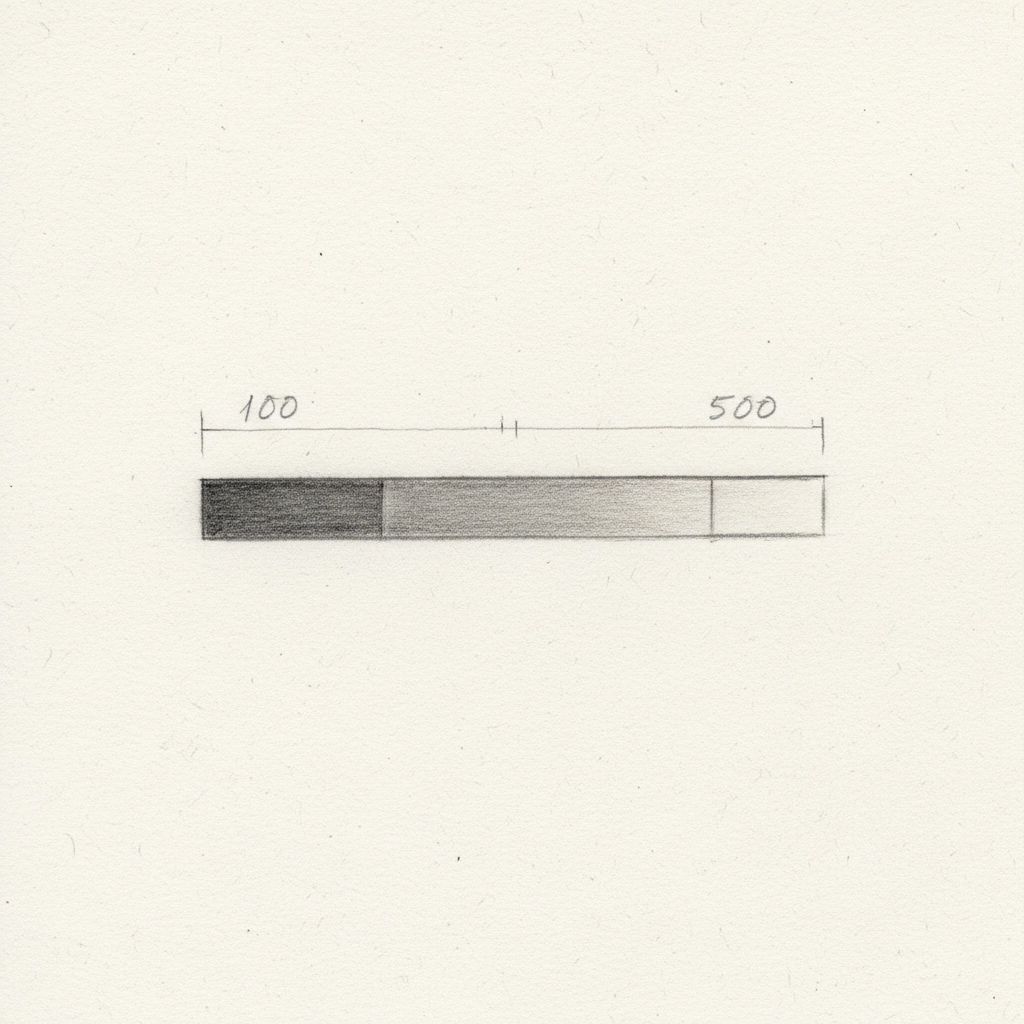
What Is the 100 ng/mL Cutoff?
EtG (Ethyl Glucuronide) is a direct metabolite of ethanol. Your liver produces it whenever alcohol enters your system. The cutoff level is simply the threshold a lab uses to call a result "positive" or "negative."
500 ng/mL (Traditional)
Detects moderate to heavy recent drinking. Incidental exposure almost never triggers a positive at this level.
100 ng/mL (Sensitive)
Detects any alcohol exposure, including small amounts consumed days ago. This is the "zero tolerance" threshold.
A program that uses 100 ng/mL is choosing sensitivity over specificity. It would rather catch every instance of drinking, even if that means occasionally flagging someone who picked up trace ethanol from hand sanitizer.
The Gray Zone: 100 to 500 ng/mL
A result between 100 and 500 ng/mL puts you in what clinicians call the "low-positive" range. A result of 280 ng/mL could mean:
- 3 beers 48 hours ago, body still clearing the metabolite
- A single glass of wine 18 hours ago
- Ethanol-containing mouthwash this morning
- Heavy, repeated hand sanitizer use
Important: In the vast majority of cases, a low-positive EtG result between 100 and 500 ng/mL still indicates some level of alcohol consumption, not incidental exposure. The science supports treating actual drinking as the default explanation.
The Elimination Timeline Most People Get Wrong
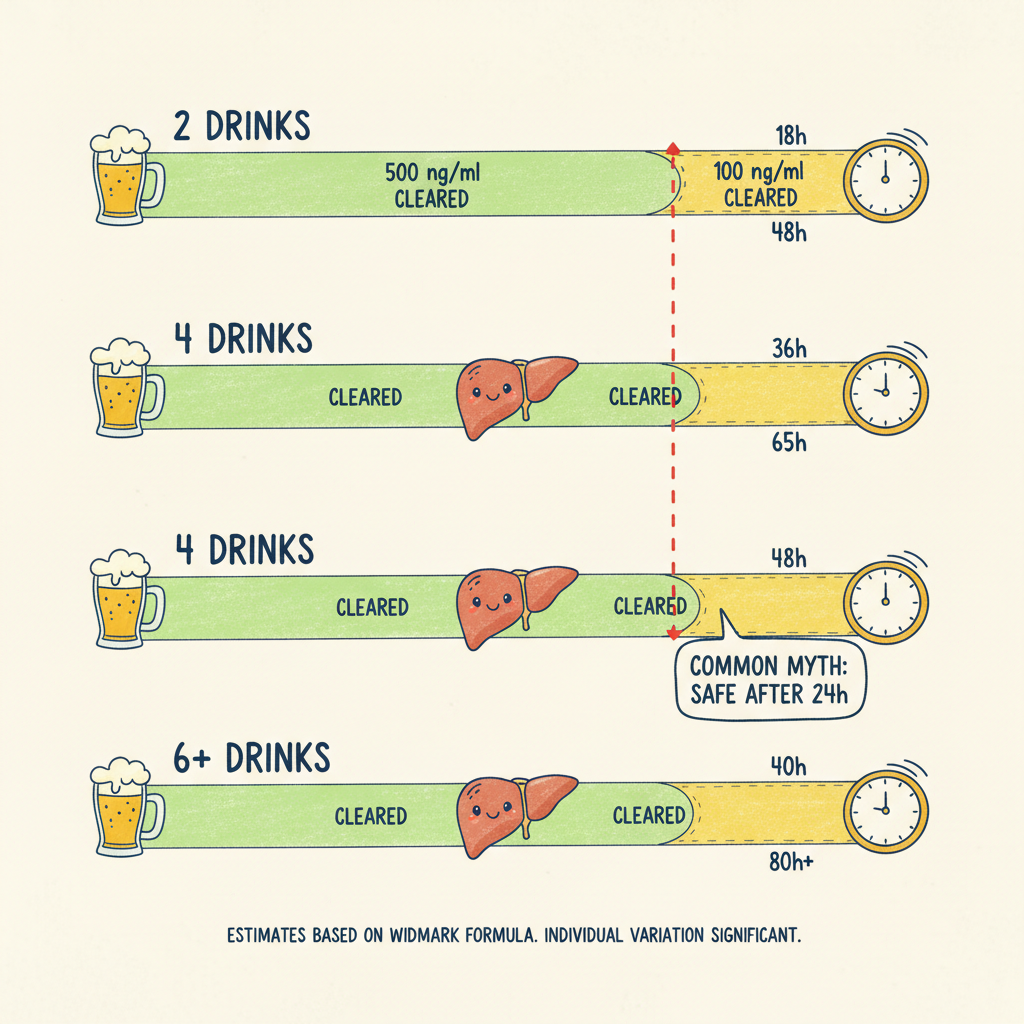
| Drinking | Clear 500 | Clear 100 | +30% Margin |
|---|---|---|---|
| 2 drinks | ~12-18h | ~36-48h | ~48-62h |
| 4 drinks | ~24-36h | ~48-65h | ~62-85h |
| 6+ drinks | ~36-48h | ~65-80h+ | ~85-104h+ |
The 100 ng/mL cutoff extends the detection window by roughly 50-100% compared to 500 ng/mL. Learn more about detection windows in our detection windows guide.
Real-World Example
A 165 lb male drank 5 beers (~7 standard drinks) on Sunday evening. Clearance to below 100 ng/mL was estimated at 70+ hours. He tested at 65 hours on Wednesday afternoon. Result: 180 ng/mL. Still positive. His metabolism ran slightly slower than average. The margin mattered.
EtG + EtS: The Confirmation Test That Changes Everything
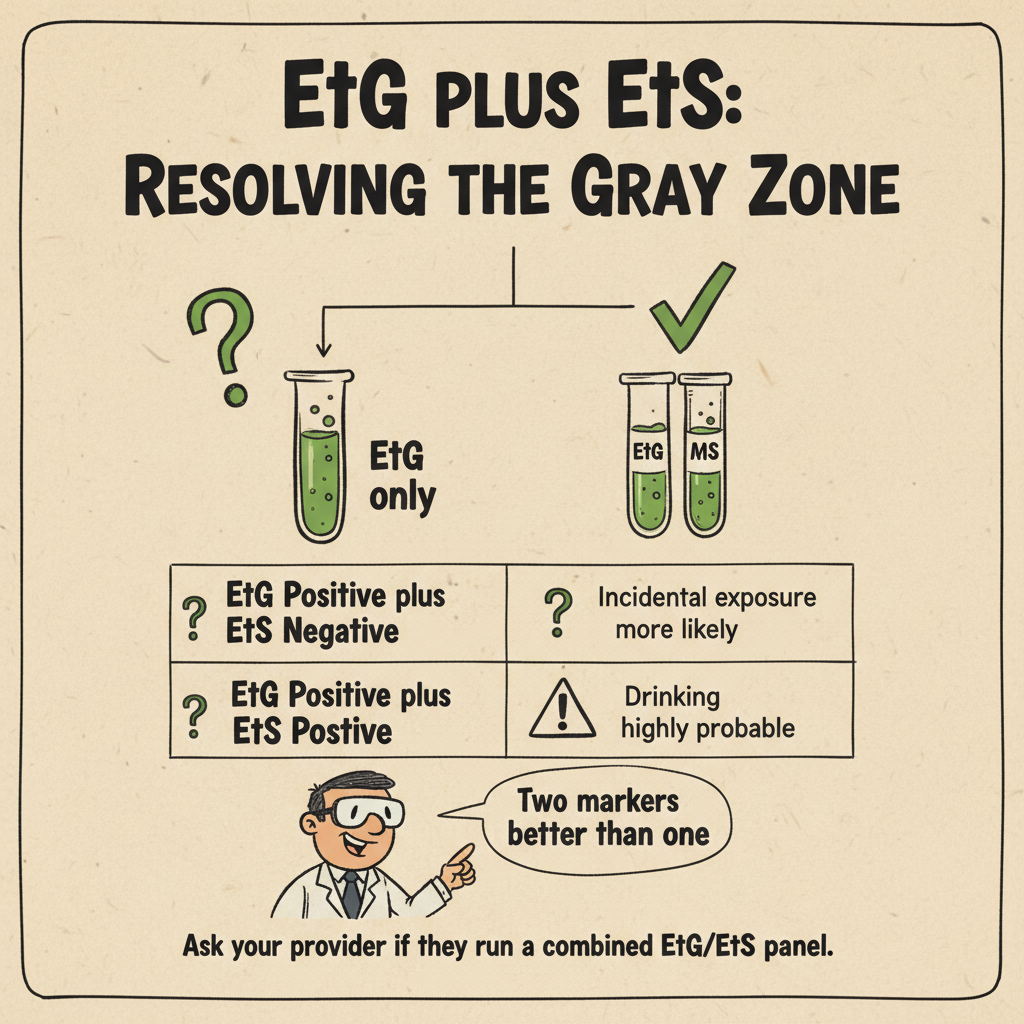
There is a second alcohol metabolite called Ethyl Sulfate (EtS). It is produced through a different metabolic pathway than EtG, and EtS is far less susceptible to environmental contamination. For more on how these biomarkers compare, see our EtG vs EtS article.
| EtG Result | EtS Result | Likely Interpretation |
|---|---|---|
| Positive (100-500) | Negative | Incidental exposure more plausible |
| Positive (100-500) | Positive | Alcohol consumption highly probable |
| Positive (>500) | Positive | Recent, significant consumption |
What This Means for You
Time is the only proven factor. No supplement or product accelerates EtG metabolism.
Add a 30% safety margin. If the math says 48 hours, plan for 62.
Ask about EtS testing. Combined testing resolves much of the gray zone ambiguity.
Frequently Asked Questions
How long does EtG stay in urine at the 100 ng/mL cutoff?
Depending on amount consumed, EtG can remain above 100 ng/mL for roughly 36 to 80+ hours after drinking. That is significantly longer than the 24-48 hour window at the 500 ng/mL cutoff. Individual variation is substantial.
Can mouthwash cause a positive EtG test at 100 ng/mL?
It is scientifically possible. Mouthwashes containing ethanol can produce transient EtG elevations above 100 ng/mL. In published studies, these elevations were generally short-lived (under 12 hours) and modest. A sustained or elevated low-positive result points more toward actual consumption.
What is the difference between the 100 and 500 ng/mL cutoffs?
The 500 ng/mL cutoff targets moderate to heavy recent drinking with high specificity. The 100 ng/mL cutoff catches any alcohol exposure, including light drinking from several days prior. The lower threshold detects more true positives but also has a higher chance of flagging incidental exposure.
What is EtS and why does it matter?
Ethyl Sulfate (EtS) is a second alcohol metabolite less prone to environmental contamination than EtG. Testing both together helps clinicians distinguish between actual consumption and incidental exposure. If EtG is positive but EtS is negative, incidental exposure becomes a more credible explanation.
Does drinking water help clear EtG faster?
No. Water can dilute urine concentration, but it does not speed up the metabolic elimination of EtG. Labs check for dilution, and an overly dilute sample may be flagged or rejected. Time is the only thing that actually lowers EtG levels.
Disclaimer: This guide is for educational purposes only. EtG Calculator provides estimates based on published pharmacokinetic models and the Widmark formula. Individual results vary significantly based on metabolism, liver function, hydration, and other factors. This tool does not provide medical advice, legal advice, or any guarantee regarding test outcomes. Always consult a qualified healthcare professional or legal advisor for decisions related to alcohol testing compliance.
Related Reading
Use our EtG Calculator to see where your estimate may fall relative to both thresholds.
Medical & Legal Disclaimer
Not Medical Advice
EtGCalc does not provide diagnosis, treatment, or medical advice. Talk with a qualified healthcare provider about alcohol use, metabolism, testing concerns, or recovery.
Not Legal Advice
EtG testing can affect probation, custody, licensing, and employment decisions. Consult a licensed attorney or your testing program for legal questions.
If You Need Support
In the United States, SAMHSA's National Helpline is 1-800-662-4357. It is free, confidential, and available 24/7.
Calculator output is an estimate, not a test prediction. Individual metabolism, hydration, kidney function, genetics, specimen handling, and lab cutoff policy can change real results. See our methodology and sources.
References
- 1SAMHSA. The Role of Biomarkers in the Treatment of Alcohol Use Disorders, 2012 Revision.
Used for biomarker context, cutoff interpretation, and incidental exposure cautions.
- 2Jatlow et al. Ethyl glucuronide and ethyl sulfate assays in clinical trials, 2014.
Used for urinary EtG and EtS kinetics after alcohol exposure.
- 3McDonell et al. Using ethyl glucuronide in urine to detect alcohol use, 2015.
Used for EtG detection window context in clinical monitoring populations.
Try the EtG Calculator
Enter your weight, number of drinks, and how long ago you drank. Everything runs in your browser. No data saved. No account needed.
Open Calculator