How Long Does Alcohol Stay on Your Breath?
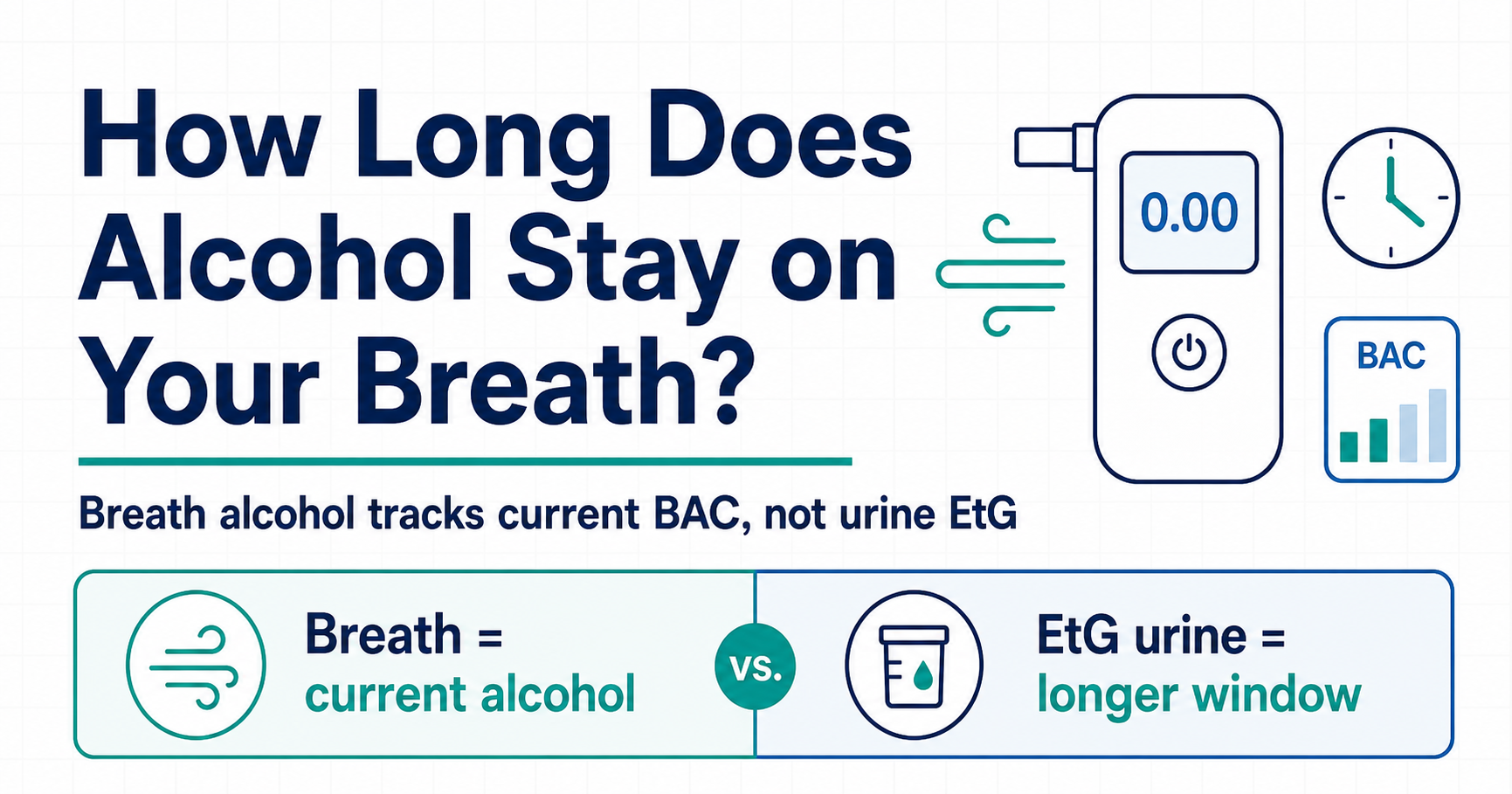
Breath alcohol is mostly a current-BAC question. EtG urine testing is a different, longer-window question. Mixing those two up leads to bad assumptions.
Editorial note
This educational page is maintained by EtGCalc and reviewed against published EtG research, SAMHSA guidance, and our calculator methodology. It does not provide medical or legal advice.
Quick answer
Alcohol can usually be detected on the breath while measurable alcohol remains in the bloodstream. For light drinking this may be a few hours; after heavier drinking, breath alcohol can remain relevant much longer and sometimes into the next morning. A breathalyzer estimates current breath alcohol. It does not answer whether EtG may still be detectable in urine.
Breath Alcohol vs BAC vs EtG
A breathalyzer estimates alcohol in your breath and uses that to estimate blood alcohol concentration, or BAC. NHTSA describes BAC as the weight of alcohol in a certain volume of blood, and notes that BAC can be measured by breathalyzer or blood test.
EtG is different. EtG is a metabolite that can remain detectable in urine after breath alcohol has already fallen. That is why someone can have no meaningful breath alcohol and still have an EtG urine question.
If your search is about current impairment, breath alcohol, or whether a person has alcohol on their breath now, think breathalyzer. If your search is about alcohol use over a longer urine window, start with the urine EtG detection guide.
Practical Timing by Drinking Amount
These ranges are practical context, not a guarantee. Alcohol timing changes with drink size, drink speed, weight, sex, food, health, and device quality.
| Drinking pattern | Breath alcohol context | Caution |
|---|---|---|
| 1 standard drink | Often a short several-hour window for many adults | Small bodies, fast drinking, and empty stomach can extend practical risk. |
| 2-3 standard drinks | Commonly still a same-day question, not a multi-day window | Do not rely on how you feel; impairment can be underestimated. |
| 4+ standard drinks | Can remain elevated for many hours | Food and slower drinking may change peak timing, but do not make alcohol disappear. |
| Overnight after heavy drinking | Residual BAC can still be present the next morning | Morning-after impairment is a real safety issue after heavy drinking. |
Breathalyzer option for current alcohol checks
If your real question is current breath alcohol rather than urine EtG, a breathalyzer is the closer tool. It still cannot guarantee safety, legality, or a future official result.
High-intent breath optionBACtrack S80 breathalyzer
BACtrack S80 professional breathalyzer on Amazon.
Best for: people who want repeat personal breath alcohol context rather than an EtG urine screen.
Check price on AmazonAs an Amazon Associate, EtGCalc earns from qualifying purchases.
Why One Drink Does Not Always Mean One Result
NIAAA defines one U.S. standard drink as about 14 grams, or 0.6 fluid ounces, of pure alcohol. That is roughly a 12-ounce beer at 5% ABV, a 5-ounce glass of wine at 12% ABV, or a 1.5-ounce shot of 40% spirits.
Real servings are often larger or stronger than a standard drink. A strong craft beer, large pour of wine, or mixed drink can count as more than one standard drink. That changes both BAC and breath alcohol timing.
Which Test Matches Your Question?
Breathalyzer
Best for: Current breath alcohol and current BAC context.
Limit: Does not answer longer urine EtG detection.
Saliva / instant alcohol strip
Best for: Very recent or current alcohol presence.
Limit: Does not estimate EtG urine metabolites.
EtG urine strip
Best for: Longer recent-use metabolite screening.
Limit: Does not measure current impairment or BAC.
Do not use breath alcohol estimates for driving decisions
NHTSA states that even small amounts of alcohol can affect driving ability. If you have been drinking, do not drive. Arrange a sober ride instead of relying on a calculator or consumer device.
Frequently Asked Questions
How long does alcohol stay on your breath?
Alcohol on your breath generally tracks current blood alcohol concentration rather than a multi-day metabolite window. For many people, breath alcohol falls over several hours, but the exact time depends on drink count, speed of drinking, body size, sex, food, and individual metabolism.
Is a breathalyzer the same as an EtG test?
No. A breathalyzer estimates current breath alcohol and is usually a short-window tool. An EtG urine test looks for ethyl glucuronide, an alcohol metabolite that can remain detectable longer after alcohol itself is gone.
Can mouthwash affect a breathalyzer?
Alcohol-containing mouthwash or recent alcohol in the mouth can affect a breath reading for a short period. Many testing protocols use an observation period before breath testing to reduce mouth-alcohol effects.
What affects breath alcohol timing?
Timing can change based on how many standard drinks you had, how quickly you drank, body weight, biological sex, food in the stomach, medications, and device quality.
Should I use EtG strips or a breathalyzer?
Use a breathalyzer for current breath alcohol context. Use EtG urine strips only when your question is whether a longer-window alcohol metabolite may still be detectable in urine.
Related Reading
BAC Chart
Understand blood alcohol level ranges by drinks, weight, and testing context.
BAC Calculator
Estimate current BAC from drink count, body weight, sex, and elapsed time.
EtG vs BAC
Understand how metabolite testing differs from current alcohol testing.
Alcohol Test Strips Guide
Compare urine EtG strips, saliva strips, dip cards, and breath tools.
At-Home EtG Test Guide
Learn what home EtG testing can and cannot tell you.
How Long Does EtG Stay in Urine?
Use this when your question is a urine EtG detection window.
References
Medical & Legal Disclaimer
Not Medical Advice
EtGCalc does not provide diagnosis, treatment, or medical advice. Talk with a qualified healthcare provider about alcohol use, metabolism, testing concerns, or recovery.
Not Legal Advice
EtG testing can affect probation, custody, licensing, and employment decisions. Consult a licensed attorney or your testing program for legal questions.
If You Need Support
In the United States, SAMHSA's National Helpline is 1-800-662-4357. It is free, confidential, and available 24/7.
Calculator output is an estimate, not a test prediction. Individual metabolism, hydration, kidney function, genetics, specimen handling, and lab cutoff policy can change real results. See our methodology and sources.