Alcohol Test Strips: EtG Urine, Saliva Strips, Dip Cards & Cutoffs
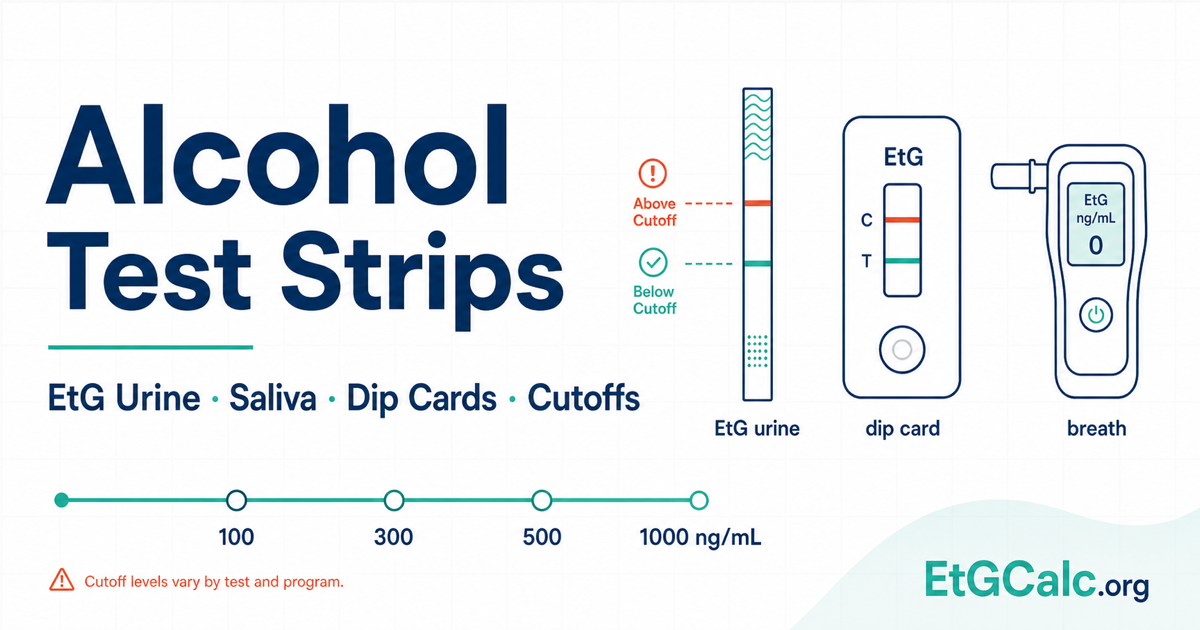
Alcohol test strips can mean EtG urine strips, dip cards, or saliva alcohol strips. They answer different questions, and none of them replace official lab confirmation.
Editorial note
This educational page is maintained by EtGCalc and reviewed against published EtG research, SAMHSA guidance, and our calculator methodology. It does not provide medical or legal advice.
Quick safety note
A home alcohol strip is a screening tool. It cannot guarantee a lab, court, probation, workplace, or treatment-program result.
What Are Alcohol Test Strips?
Alcohol test strips can refer to two different kinds of screening tools: saliva or instant alcohol strips for very recent/current alcohol presence, and EtG urine strips or dip cards for a longer recent-use biomarker window.
This page focuses on EtG urine strips and dip cards because they are the better match for alcohol detection-window questions. If your question is current breath alcohol, a breathalyzer or short-window alcohol screen may be more relevant.
Alcohol Test Strip Options
Check each product's cutoff, expiration date, package size, and instructions before buying. A home strip should match the question you are trying to answer.
Home EtG test strips
Prime Screen EtG alcohol urine test strips.
Best for: People who want multiple strip tests for repeated personal screening
Check price on AmazonDip cardEtG dip card test
Xlar EtG 300 alcohol urine QTest dip card.
Best for: People who prefer a dip-card format with a fixed EtG cutoff
Check price on AmazonAs an Amazon Associate, EtGCalc earns from qualifying purchases.
What to Check Before Buying Alcohol Test Strips
Cutoff level
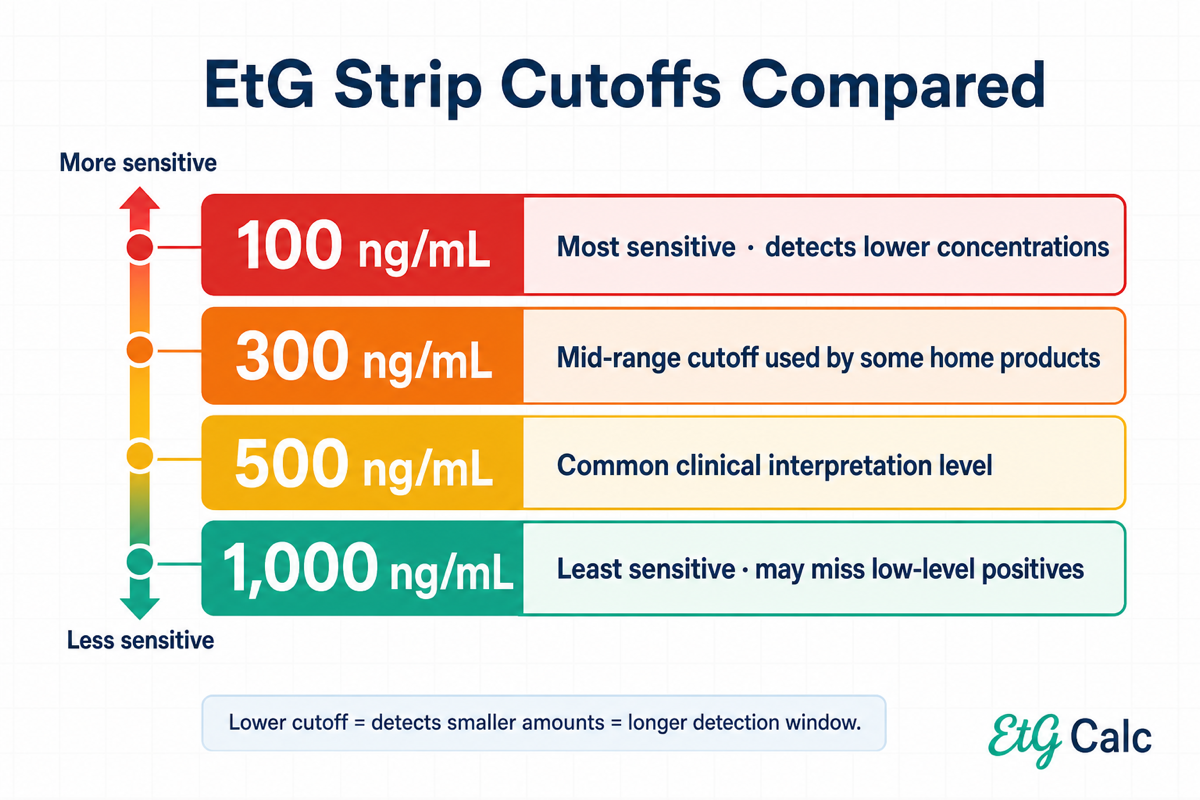
Look for the ng/mL cutoff on the box or listing. Common EtG cutoffs include 100, 300, 500, and 1,000 ng/mL.
Specimen type
Most EtG strips are urine tests. Saliva alcohol strips answer a different question and usually cover a shorter window.
Expiration date
Expired test strips may produce unreliable lines or invalid results.
Read-time window
Rapid strips often require reading at a specific minute mark. Reading too early or too late can mislead you.
Storage conditions
Heat, humidity, and damaged packaging can affect strip performance.
Confirmation policy
Home strips usually do not include lab confirmation, EtS testing, or specimen-validity checks.
Saliva / Instant Alcohol Strips vs EtG Urine Strips
Some people searching for alcohol test strips are looking for saliva strips or instant alcohol strips, not EtG urine strips. These tools answer a different question.
| Test type | Main question | Better fit |
|---|---|---|
| Saliva / instant alcohol strips | Is alcohol present right now or very recently? | Current-use checks, workplace screening context, or household safety questions. |
| EtG urine strips | Is an alcohol-use metabolite still detectable after drinking? | Recent-use screening over a longer window than breath or saliva alcohol. |
| Breathalyzer | What is the current breath alcohol estimate? | Current impairment context and repeat personal monitoring. |
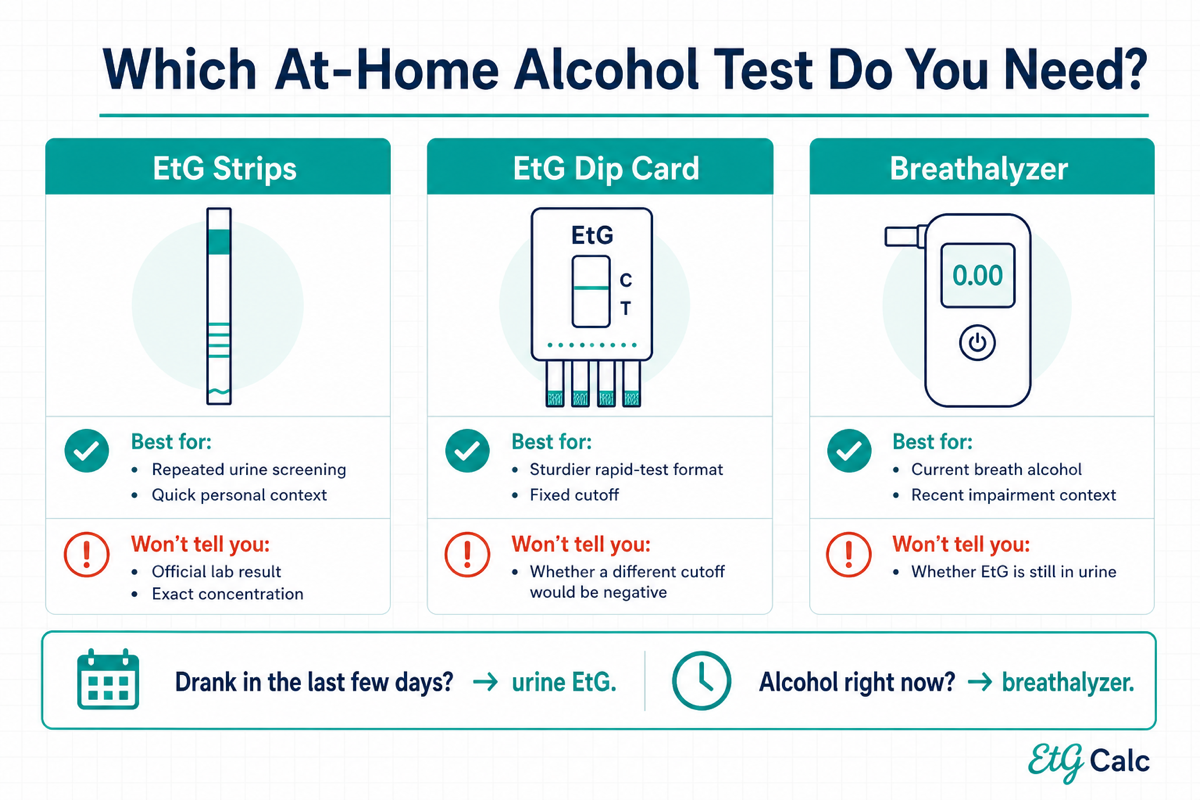
If your question is current breath alcohol, a breathalyzer is usually a closer match than an EtG urine strip. If your question is whether an EtG metabolite may remain detectable in urine, focus on EtG strips and their cutoff level.
EtG Strip Cutoffs: 100 vs 300 vs 500 ng/mL
| Cutoff | What it means | Practical caution |
|---|---|---|
| 100 ng/mL | More sensitive; can detect lower EtG concentrations. | Can be more affected by incidental exposure and low-level positives. |
| 300 ng/mL | Middle-ground cutoff used by some home products. | Not the same as a 100 or 500 ng/mL lab cutoff. |
| 500 ng/mL | Less sensitive than 100 ng/mL and commonly discussed in clinical interpretation. | A negative 500 ng/mL strip does not prove a negative 100 ng/mL lab result. |
| 1,000 ng/mL | Screens for higher EtG concentrations. | May miss lower-level positives that stricter programs care about. |
If you do not know which cutoff an official program uses, do not assume a home strip answers that question. Read our 100 ng/mL cutoff guide and compare timing with the calculator.
EtG Strips vs Dip Cards vs Breathalyzers
| Option | Best for | Does not tell you |
|---|---|---|
| EtG strips | Repeated urine screening and quick personal context. | Official lab result or exact concentration. |
| EtG dip cards | A sturdier rapid-test format with a fixed cutoff. | Whether a different cutoff would be negative. |
| Breathalyzer | Current breath alcohol and recent impairment context. | Whether EtG metabolites are still detectable in urine. |
How to Use a Home Alcohol Strip Responsibly
Reasonable uses
- Understanding whether EtG may still be above a product cutoff.
- Comparing a home screen with an estimated detection timeline.
- Learning how cutoff differences change interpretation.
Risky uses
- Treating one home strip as a guaranteed official result.
- Ignoring a stricter cutoff used by a lab or program.
- Using a strip alone for legal, medical, employment, or probation decisions.
Estimate your detection window first
A strip only answers one cutoff at one moment. Use the calculator to understand how drinks, body weight, time, and cutoff level can change the estimate.
When breath testing is the better tool
If your question is whether alcohol is currently present on your breath, a breathalyzer is more relevant than an EtG urine strip. EtG strips and breathalyzers answer different questions.
BACtrack S80 breathalyzer
BACtrack S80 professional breathalyzer on Amazon.
Best for: Checking current breath alcohol instead of urine EtG metabolites
Check price on AmazonFrequently Asked Questions
What do alcohol test strips detect?
Most urine alcohol test strips sold for recent drinking questions detect EtG, a metabolite produced after alcohol is processed. Breathalyzers measure current breath alcohol, not EtG.
Are alcohol test strips the same as EtG test strips?
Usually, when people search for urine alcohol test strips, they mean EtG strips or EtG dip cards. Always check the product label because cutoff level and specimen type can differ.
What cutoff should I look for?
Common EtG strip cutoffs include 100, 300, 500, and 1,000 ng/mL. A lower cutoff is more sensitive. A home strip with one cutoff cannot predict how a lab using a different cutoff will interpret a sample.
Can an alcohol test strip guarantee I will pass a lab test?
No. Home strips are screening tools only. Official results can depend on lab cutoff, confirmation testing, specimen validity checks, chain of custody, and program rules.
Where can I buy alcohol test strips?
People commonly buy EtG alcohol test strips through online retailers such as Amazon or testing suppliers. Check the cutoff, expiration date, instructions, and seller details before ordering.
Are saliva alcohol strips different from EtG urine strips?
Yes. Saliva or instant alcohol strips are usually aimed at current or very recent alcohol presence. EtG urine strips are aimed at a longer recent-use biomarker window.
Related Reading
Medical & Legal Disclaimer
Not Medical Advice
EtGCalc does not provide diagnosis, treatment, or medical advice. Talk with a qualified healthcare provider about alcohol use, metabolism, testing concerns, or recovery.
Not Legal Advice
EtG testing can affect probation, custody, licensing, and employment decisions. Consult a licensed attorney or your testing program for legal questions.
If You Need Support
In the United States, SAMHSA's National Helpline is 1-800-662-4357. It is free, confidential, and available 24/7.
Calculator output is an estimate, not a test prediction. Individual metabolism, hydration, kidney function, genetics, specimen handling, and lab cutoff policy can change real results. See our methodology and sources.
References
- 1SAMHSA. The Role of Biomarkers in the Treatment of Alcohol Use Disorders, 2012 Revision.
Used for biomarker context, cutoff interpretation, and incidental exposure cautions.
- 2Jatlow et al. Ethyl glucuronide and ethyl sulfate assays in clinical trials, 2014.
Used for urinary EtG and EtS kinetics after alcohol exposure.
- 3McDonell et al. Using ethyl glucuronide in urine to detect alcohol use, 2015.
Used for EtG detection window context in clinical monitoring populations.