Can You Pass an EtG Test in 24 Hours? Here's What the Science Says
You drank last night. Your test is tomorrow. You need numbers, not guesswork.
Editorial note
This educational page is maintained by EtGCalc and reviewed against published EtG research, SAMHSA guidance, and our calculator methodology. It does not provide medical or legal advice.
The Short Answer
For moderate drinking (3-4 standard drinks) with a 500 ng/mL cutoff, most people will test below the threshold within 24 hours. For heavy drinking or a stricter 100 ng/mL cutoff, 24 hours is often not enough.
What EtG Is and Why It Sticks Around
Standard alcohol tests measure ethanol, the alcohol itself. EtG tests measure something different: ethyl glucuronide, a byproduct your liver creates as it processes alcohol. EtG stays in your urine far longer than alcohol stays in your blood.
That's exactly why probation officers, drug courts, and some employers prefer EtG testing. It can flag alcohol use days after your last drink, not just hours.
But there's a big gap between "can detect" and "will detect." That gap is where the math matters. For more on how this works, see our guide to calculating EtG levels.
The 80-Hour Number Is Misleading
Search this topic and you'll see "EtG is detectable for up to 80 hours" repeated everywhere. That claim causes a lot of unnecessary panic.
The Context Behind "80 Hours"
Researchers gave subjects a large amount of alcohol and tested with an extremely sensitive 100 ng/mL cutoff. Under those specific laboratory conditions, traces were still measurable at 80 hours. Most real-world tests use a 500 ng/mL cutoff, which is five times less sensitive.
Think of it like a car's top speed. A manufacturer might rate a vehicle at 200 mph. Technically accurate on a test track. But that tells you nothing about your daily commute. Read more in our article on debunking the 80-hour EtG myth.
How EtG Leaves Your System
After your body finishes processing alcohol, EtG levels follow a predictable decline. The concentration drops by roughly half every 2 to 3 hours. Pharmacologists call this the half-life.
| Hours After Peak | Estimated EtG Level |
|---|---|
| 0 | 10,000 ng/mL |
| 2.5 hours | 5,000 ng/mL |
| 5 hours | 2,500 ng/mL |
| 7.5 hours | 1,250 ng/mL |
| 10 hours | 625 ng/mL |
| 12.5 hours | ~312 ng/mL |
| 15 hours | ~156 ng/mL |
In this example, you'd cross below the 500 ng/mL line somewhere around 10-12 hours after your EtG peaked. You'd drop below 100 ng/mL around 17-18 hours. The critical question: how high did your EtG peak in the first place?
EtG Test After 24, 36, 48, or 72 Hours
The question is not just whether 24 hours is enough. The realistic answer changes by drinking amount, cutoff level, and whether the test uses 100 ng/mL or 500 ng/mL. Use this table as educational context, not as a guarantee of any result.
| Time since drinking | What it usually means | Best next resource |
|---|---|---|
| 24 hours | Often enough after light or moderate drinking at 500 ng/mL, but risky after heavy drinking or at 100 ng/mL. | Run the calculator |
| 36 hours | More realistic for many moderate-to-heavy scenarios, though sensitive cutoffs can still matter. | Compare cutoff levels |
| 48 hours | Usually below common cutoffs for many single-day drinking events, but multi-day drinking can extend the window. | Read urine window guide |
| 72 hours | A wider buffer for most non-extreme cases, but still not a substitute for program rules or lab testing. | Understand home EtG tests |
If you are trying to understand a specific test window such as 36, 48, 52, 62, or 72 hours, the safer framing is: estimate the remaining EtG level, compare it to the cutoff, then leave room for individual variability.
Three Real Scenarios at 24 Hours
Note: These estimates are based on pharmacokinetic modeling using the Widmark formula. These are mathematical approximations, not clinical measurements. All scenarios assume a 180 lb (82 kg) male.
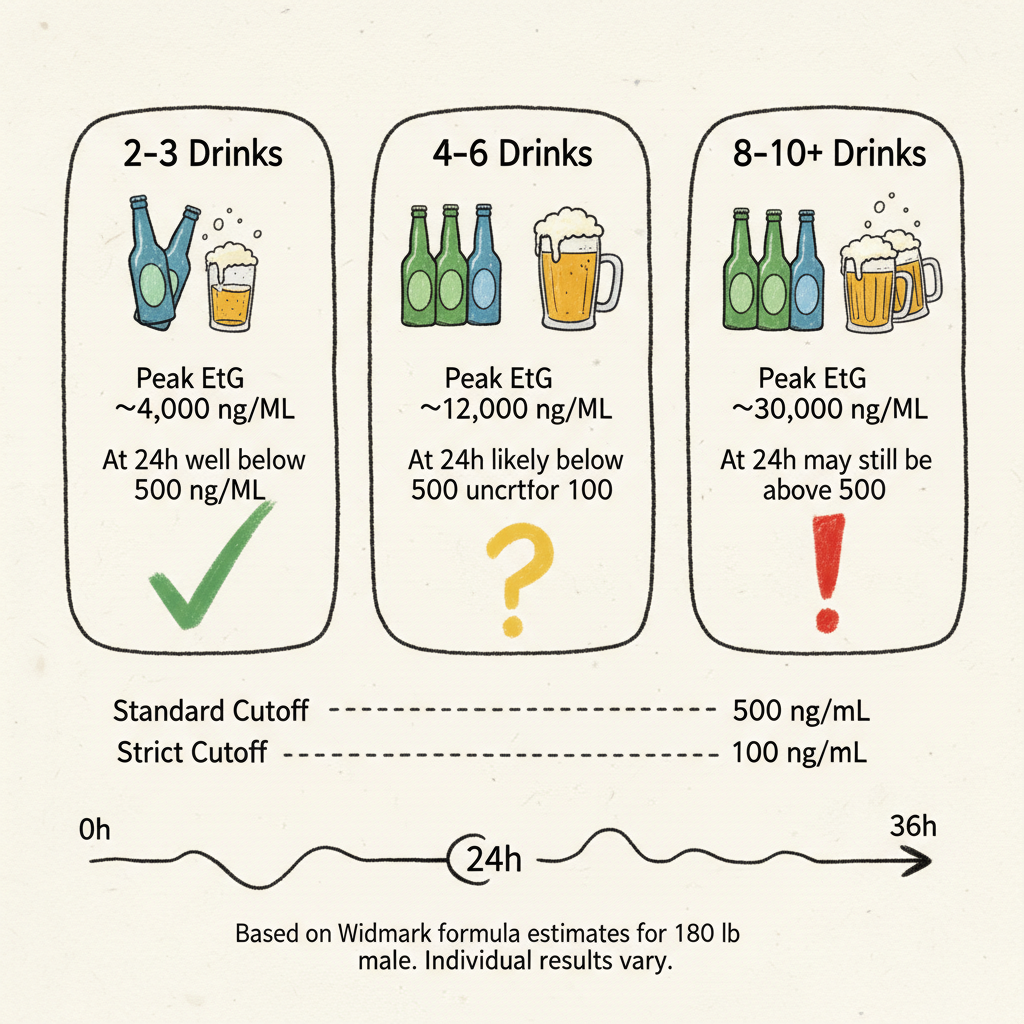
Scenario 1: 2-3 standard drinks
- Estimated peak EtG: ~3,000-5,000 ng/mL
- Time below 500 ng/mL: ~8-12 hours
- Time below 100 ng/mL: ~14-18 hours
- At 24 hours: very likely below both cutoffs
Scenario 2: 4-6 standard drinks
- Estimated peak EtG: ~8,000-15,000 ng/mL
- Time below 500 ng/mL: ~12-18 hours
- Time below 100 ng/mL: ~18-26 hours
- At 24 hours: likely below 500; uncertain for 100 ng/mL
Scenario 3: 8-10+ standard drinks
- Estimated peak EtG: ~20,000-40,000 ng/mL
- Time below 500 ng/mL: ~18-28 hours
- Time below 100 ng/mL: ~26-36 hours
- At 24 hours: may still be above 500 ng/mL
The Cutoff Level Changes Everything
This is the single most overlooked factor.
A 500 ng/mL cutoff (the SAMHSA-recommended standard for most legal and workplace testing) gives you a significantly shorter detection window than a 100 ng/mL cutoff (sometimes used in zero-tolerance clinical programs).
The gap between these two thresholds can mean 8-12 additional hours of detection time. Learn more about what these cutoffs mean in our guide to the 100 ng/mL cutoff.
What Won't Help
❌ Drinking Tons of Water
Labs check for dilution. Dilute samples can count as a failure or force a retest.
❌ "Detox" Drinks
No published clinical evidence that any product speeds up EtG metabolism.
❌ Exercise & Saunas
EtG is broken down by the liver, not sweated out in any meaningful amount.
✅ Time Is the Only Factor
Your liver will process EtG at its own pace. Nothing you buy or drink will rush it.
Frequently Asked Questions
Can you pass an EtG test after 24 hours?
For moderate drinking (3-4 standard drinks) with a 500 ng/mL cutoff, most people will test below the threshold within 24 hours. For heavy drinking or a stricter 100 ng/mL cutoff, 24 hours is often not enough.
How long does it take for EtG to drop below 500 ng/mL?
For 2-3 standard drinks, EtG typically drops below 500 ng/mL within 8-12 hours. For 4-6 drinks, approximately 12-18 hours. For 8-10+ drinks, it may take 18-28 hours.
Does drinking water help you pass an EtG test faster?
No. Drinking water may dilute your urine, but labs check for dilution. If your sample is flagged as dilute, it can count as a failure or force a retest. Water does not speed up EtG metabolism.
What is the half-life of EtG in urine?
EtG has a half-life of approximately 2 to 3 hours. This means the concentration drops by roughly half every 2-3 hours after your EtG level peaks.
Is the 80-hour EtG detection window accurate?
The 80-hour figure is misleading for most people. It comes from studies using heavy alcohol doses tested at the most sensitive 100 ng/mL cutoff. Most real-world tests use 500 ng/mL, which has a much shorter detection window.
Disclaimer: This article is for educational and informational purposes only. It does not constitute medical advice, legal counsel, or a guarantee of any test result. EtG metabolism varies significantly between individuals due to factors including liver health, medications, age, and genetic differences. The estimates provided are based on pharmacokinetic modeling and should not be treated as precise predictions. When the stakes are high, the safest choice is always to allow more time. Consult a qualified healthcare provider or legal professional for guidance specific to your situation.
Related Reading
For a personalized estimate based on your weight and drinking history, use our free EtG Calculator.
Medical & Legal Disclaimer
Not Medical Advice
EtGCalc does not provide diagnosis, treatment, or medical advice. Talk with a qualified healthcare provider about alcohol use, metabolism, testing concerns, or recovery.
Not Legal Advice
EtG testing can affect probation, custody, licensing, and employment decisions. Consult a licensed attorney or your testing program for legal questions.
If You Need Support
In the United States, SAMHSA's National Helpline is 1-800-662-4357. It is free, confidential, and available 24/7.
Calculator output is an estimate, not a test prediction. Individual metabolism, hydration, kidney function, genetics, specimen handling, and lab cutoff policy can change real results. See our methodology and sources.
References
- 1SAMHSA. The Role of Biomarkers in the Treatment of Alcohol Use Disorders, 2012 Revision.
Used for biomarker context, cutoff interpretation, and incidental exposure cautions.
- 2Jatlow et al. Ethyl glucuronide and ethyl sulfate assays in clinical trials, 2014.
Used for urinary EtG and EtS kinetics after alcohol exposure.
- 3McDonell et al. Using ethyl glucuronide in urine to detect alcohol use, 2015.
Used for EtG detection window context in clinical monitoring populations.
Calculate Your Own Estimate
Enter your weight, number of drinks, and hours since your last drink. 100% private — runs entirely in your browser.
Open Calculator