EtG Test After 24, 48, or 72 Hours: What the Window Means
EtG timing questions usually sound like "24 hours," "48 hours," or "62 hours." The safer answer is not a shortcut. It is a cutoff-based estimate that depends on drinking amount, timing, and urine test sensitivity.
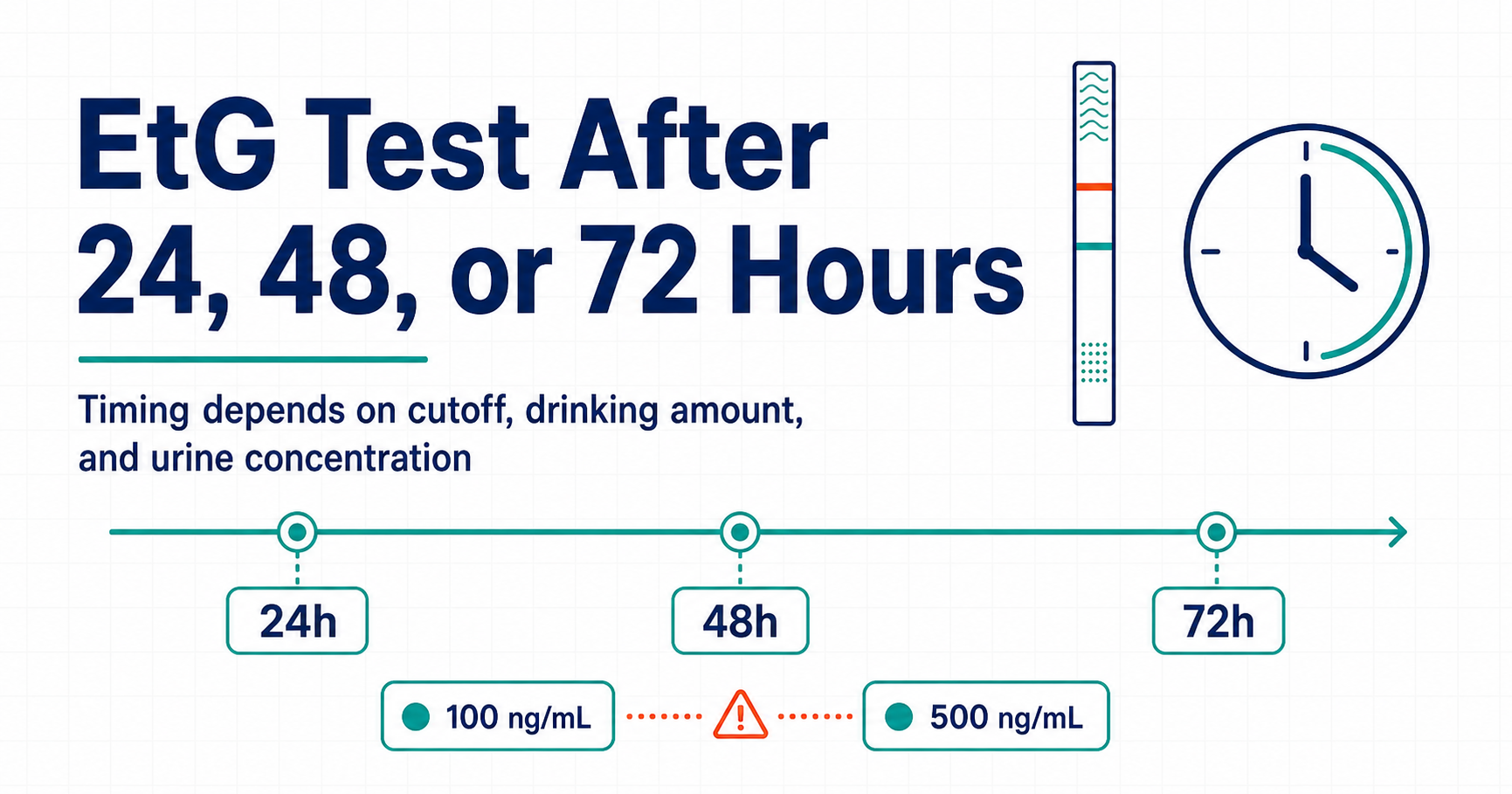
Quick answer
A 24-hour EtG test can still be uncertain, especially after heavier drinking or with a 100 ng/mL cutoff. At 48 hours, many light or moderate one-day drinking scenarios are below common cutoffs, but multi-day drinking can extend the window. At 72 hours, most non-extreme scenarios have more buffer, but no timeline guarantees a lab result.
Editorial note
This educational page is maintained by EtGCalc and reviewed against published EtG research, SAMHSA guidance, and our calculator methodology. It does not provide medical or legal advice.
This is not a "how to pass" guide
This page explains detection windows and cutoff interpretation. It does not provide legal advice, medical advice, or tactics to evade testing. Program rules, lab methods, and official results control real decisions.
EtG Test Timing Table: 24, 36, 48, 52, 62, and 72 Hours
These are educational interpretation windows. The same person can have a different answer at a 100 ng/mL cutoff than at a 500 ng/mL cutoff.
| Time since last drink | Typical context | Cutoff note | Best next step |
|---|---|---|---|
| 24 hours | Often still uncertain after moderate or heavy drinking, especially with a 100 ng/mL cutoff. | At 500 ng/mL, light drinking may be below the cutoff. At 100 ng/mL, the tail can last longer. | Use the calculator with your exact drinks, weight, and cutoff. |
| 36 hours | More realistic for many moderate single-day drinking scenarios, but not a guarantee. | A 100 ng/mL cutoff can still matter, particularly after heavier drinking or multi-day drinking. | Compare 100 vs 500 ng/mL in the cutoff guide. |
| 48 hours | Often below common cutoffs for light or moderate one-day drinking, but individual variation remains. | Heavy or repeated drinking can push the detection window past two days. | Review the urine detection window guide if the drinking event was heavier. |
| 52 hours | Similar to 48 hours, with slightly more buffer. Still depends on dose, cutoff, and urine concentration. | The extra four hours helps, but a strict cutoff and high starting level can still change the answer. | Check the EtG levels chart for scenario comparisons. |
| 62 hours | A wider buffer for many non-extreme cases, but not a universal negative-result point. | Most uncertainty at this point comes from heavy/multi-day drinking, strict cutoffs, or lab policy. | Use this as a context window, not a promise. |
| 72 hours | A common upper-end buffer for many real-world scenarios, though extreme cases can last longer. | The often-quoted 80-hour window usually reflects heavier exposure and sensitive testing. | Read the 80-hour myth guide for context. |
Why the Same Hour Can Mean Different Things
Drink amount
More standard drinks generally create a higher EtG peak, which takes longer to fall below a cutoff.
Cutoff level
A 100 ng/mL cutoff is stricter than 500 ng/mL. The same sample can be positive at 100 and negative at 500.
Body and metabolism
Weight, sex, liver health, drinking pattern, and individual metabolism can shift the estimate.
Urine concentration
Hydration can change urine concentration, and labs may check creatinine or specific gravity.
Need a scenario estimate?
Use the urine EtG calculator for your own weight, drink count, timing, and cutoff instead of relying on a single hour-based rule.
24 Hours vs 48 Hours vs 72 Hours
The first day is where people most often overestimate certainty. If someone drank lightly, a 24-hour window may be enough at a 500 ng/mL cutoff. If the event involved heavier drinking, repeated drinking, or a stricter cutoff, 24 hours can still be inside the detection tail.
By 48 hours, many one-day drinking scenarios have more room below common cutoffs, but not all. Multi-day drinking, high starting EtG levels, and individual metabolism can keep the window open longer.
By 72 hours, the window is wider for most non-extreme cases. The famous "80-hour" number is best understood as an upper-end context, not a rule for every person or every test. For more detail, see the 80-hour EtG myth guide.
At-Home Testing Context
At-home EtG strips and dip cards can provide personal screening context, but they do not replace official lab testing. Check the product cutoff before comparing a home result with a lab or program.
A home strip at 300 or 500 ng/mL is not the same as a lab using 100 ng/mL. If you use a home strip, read it only as a rough personal signal and follow official guidance for any real-world decision.
As an Amazon Associate, EtGCalc earns from qualifying purchases.
Frequently Asked Questions
Can you pass an EtG test after 24 hours?
Sometimes, but 24 hours is often uncertain. Light drinking may fall below a 500 ng/mL cutoff by then, while heavier drinking or a 100 ng/mL cutoff can remain detectable longer.
Can you pass an EtG test in 36 hours?
Thirty-six hours gives more buffer than 24 hours and may be enough for many moderate single-day scenarios, but it still depends on drink amount, cutoff level, urine concentration, and individual metabolism.
Can I pass an EtG test in 48 hours?
Many light or moderate one-day drinking scenarios are below common cutoffs by 48 hours, but no page can guarantee a result. Heavy or multi-day drinking, strict cutoffs, and lab rules can extend the window.
What about an EtG test after 52 or 62 hours?
52 and 62 hours provide more time than the common 48-hour question, but interpretation still depends on starting level and cutoff. Treat those times as wider buffers, not automatic negative-result points.
Is 72 hours enough for an EtG test?
Seventy-two hours is a wider buffer for many non-extreme cases. The 80-hour claim usually refers to heavier exposure and sensitive testing, so 72 hours should still be interpreted with context.
Related Reading
EtG Urine Test Calculator
Estimate urine EtG timing against common cutoffs.
EtG Levels Chart
Compare levels by drinks, time, and cutoff.
Can You Pass an EtG Test in 24 Hours?
Focused 24-hour scenario analysis.
How Long Does EtG Stay in Urine?
Broader urine detection window explanation.
100 ng/mL Cutoff Explained
Why stricter cutoffs extend uncertainty.
At-Home EtG Test Guide
Home strips, dip cards, and responsible use.
Medical & Legal Disclaimer
Not Medical Advice
EtGCalc does not provide diagnosis, treatment, or medical advice. Talk with a qualified healthcare provider about alcohol use, metabolism, testing concerns, or recovery.
Not Legal Advice
EtG testing can affect probation, custody, licensing, and employment decisions. Consult a licensed attorney or your testing program for legal questions.
If You Need Support
In the United States, SAMHSA's National Helpline is 1-800-662-4357. It is free, confidential, and available 24/7.
Calculator output is an estimate, not a test prediction. Individual metabolism, hydration, kidney function, genetics, specimen handling, and lab cutoff policy can change real results. See our methodology and sources.
References
- 1SAMHSA. The Role of Biomarkers in the Treatment of Alcohol Use Disorders, 2012 Revision.
Used for biomarker context, cutoff interpretation, and incidental exposure cautions.
- 2Jatlow et al. Ethyl glucuronide and ethyl sulfate assays in clinical trials, 2014.
Used for urinary EtG and EtS kinetics after alcohol exposure.
- 3McDonell et al. Using ethyl glucuronide in urine to detect alcohol use, 2015.
Used for EtG detection window context in clinical monitoring populations.